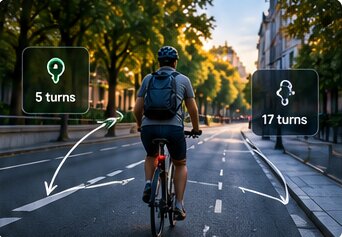
Ask a navigation app for the way across town and you get the shortest route, or the fastest. Both are measured in one unit: kilometres, or the minutes they take at an assumed speed. Neither unit notices the thing that actually makes a city ride tiring: how often you have to stop thinking about riding and start thinking about navigating.
What a turn costs
Picture one junction where the route leaves your street. Fifty metres before it you glance at the phone, or listen for the cue. You brake. You check the traffic coming the other way, signal, wait for a gap or a light, turn, and accelerate back up to speed. Call it ten seconds of lost time and a good deal more of lost attention. Now do that seventeen times in six kilometres, about every 350 metres. You never settle into a rhythm. You are never sure the next turn is not the one you will miss.
A missed turn is where it gets expensive. The app reroutes, often by asking you to turn around, and the ride you planned to be quick becomes a small argument with a phone at a kerb.
Junctions are also where cyclists meet cars at angles. Fewer of them does not make a route safe, and Spokli never claims it does. But every decision you do not have to make at a junction is attention you keep for the road.
Why kilometres are the wrong unit
The two routes on the example card on our home page differ by 700 metres and about one minute. That is the entire price of going from seventeen decisions to five, from eleven traffic lights to four, and from 800 metres of cobblestones to none. Measured in kilometres, the Comfort route loses. Measured in anything a rider feels, it wins by a distance.
So Spokli does not add kilometres to turn counts. It converts everything to one currency: minutes a rider would trade. Riding time is the base. Each traffic light adds the waiting you can expect plus a stop and a restart. Each meaningful turn adds a cost that, in the current Comfort model, is worth roughly a minute and a half of riding, and a left turn off a main road adds more, because on a bike that is two crossings and two waits. The route with the lowest total wins. A detour that saves more interruptions than it costs in distance comes out ahead, and a detour that does not stays off the card.
What counts as a turn
This only works if the count is honest. A bend in a cycleway is not a decision. A street that changes its name halfway is not a decision. Moving from a road onto its own cycle track, or back, is not a decision either, even though the map draws it as two separate lines. Spokli recognises those pairs, about thirteen thousand of them in Berlin, and treats them as one corridor.
What remains are real decisions: junctions where you leave your corridor, forks where the obvious way is not the right one, roundabout exits. When two of those fall within thirty metres of each other, Spokli counts and announces them as one manoeuvre, because that is how you ride them.
Fast still exists
None of this makes the fast route wrong. Spokli always shows it, with its own count of turns and lights, and on a day when you simply want to be quick you take it. Fast is pure time: riding plus the waiting you can expect. It gets no turn penalty at all, because a fast route that avoids turns for their own sake is not fast any more.
Comfort is the route for the other days. It is allowed to be at most 20 percent longer and five minutes slower than Fast, and it tells you exactly how much of that budget it spent and what you got for it. If your city rides feel like a sequence of small interruptions, that sentence on the card is the one to read.
Read more: Comfort routes · ← All articles