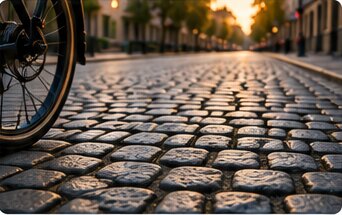
Every Berlin cyclist has a street they avoid without thinking: the one where the sett stones start and the handlebars begin to hum. Cobblestones, or more precisely sett paving, are still the surface of hundreds of side streets here, especially in the eastern districts and in the old village cores that the city grew around. They are part of what Berlin looks like. They are also the single biggest reason a route that looks fine on a map is not fine under a bicycle.
What a map calls “paved”
Most routing engines know whether a street is paved. That is not enough. OpenStreetMap distinguishes asphalt, concrete, paving stones, sett and cobblestones, and separately records smoothness where mappers have judged it. But a street without a surface tag is just “paved”, which could mean anything from fresh asphalt to a century of granite blocks.
Spokli keeps the distinction. Smooth asphalt, uneven paving, cobblestones, gravel and unpaved ground are separate classes, and “unknown” is its own class rather than a quiet assumption of asphalt. Where OpenStreetMap is silent, the bbbike project fills the gap: a quarter-century of hand-surveyed surface grades for Berlin’s streets, which also correct the odd street that OpenStreetMap calls smooth and riders know is not.
One more Berlin detail matters. Many cobbled streets have a separate cycle track with its own, usually smoother, surface. On Lilienthalstraße, for instance, the carriageway is sett and the track is paving stones. Spokli uses the surface you would ride, the track’s, not the road’s.
What a cobblestone stretch costs
In the Comfort route, a stretch of cobblestones counts for about two and a half times its riding time. A 400-metre cobbled block that takes ninety seconds to ride is weighed as if it took almost four minutes. That is enough to send Comfort one street over to the asphalt, as long as the detour stays within its budget of 20 percent more distance and five more minutes. The card then tells you what happened: a little longer, no cobblestones, and usually fewer turns too, because the parallel asphalt street is often the bigger one.
The Fast route does not pay this penalty. Fast is pure time, and cobblestones do slow you down a little, but Fast will happily send you across them if that is quicker. Both routes show their cobblestone metres, so you can see the trade before you choose.
When you want none at all
A preference is not a rule. If your tyres are narrow, your back is bad or your child is on the rear seat, you can exclude cobblestones outright as a hard avoid. Then no route will use them, no matter how much time that costs. Spokli shows the price of the rule as well: how much longer the shortest possible route becomes once cobblestones are forbidden. For most trips it is a few hundred metres. For a few, the honest answer is that there is no cobble-free way to your door, and the app says so and lets you allow them for this one ride.
Where to expect them
Without pretending to a street-by-street atlas: the side streets of the eastern inner city, the old village centres across the whole city, many residential streets in the outer districts that were never resurfaced, and the courtyards and short connecting streets everywhere. The pattern is historical, not random, and the open data captures most of it. Where it does not, your post-ride report in the app is how we learn. Pick the stretch, choose “surface”, and the next rider gets a better route.
Read more: Berlin · ← All articles